Floréal Villanova
Aug 28, 2025
Decoding the latest solar announcements in Quebec
The Quebec government has recently announced measures related to solar energy, sparking many questions. What lies behind these announcements? Which government entities are involved? And what does this mean for solar energy development in the province?
In this video, we break down the announcement with Patrick Goulet from Énergie Solaire Québec. Together, we shed light on the mechanisms at play and clarify what’s really happening behind the scenes.
🔎 Key highlights of this resource:
This content is part of our ongoing mission to demystify solar energy and make it more accessible to everyone in Quebec and beyond.
Find Hydro-Québec’s press release here
Ready for the demand these subsidies will bring? Discover how Otonomi DX helps solar professionals size and quote projects faster.
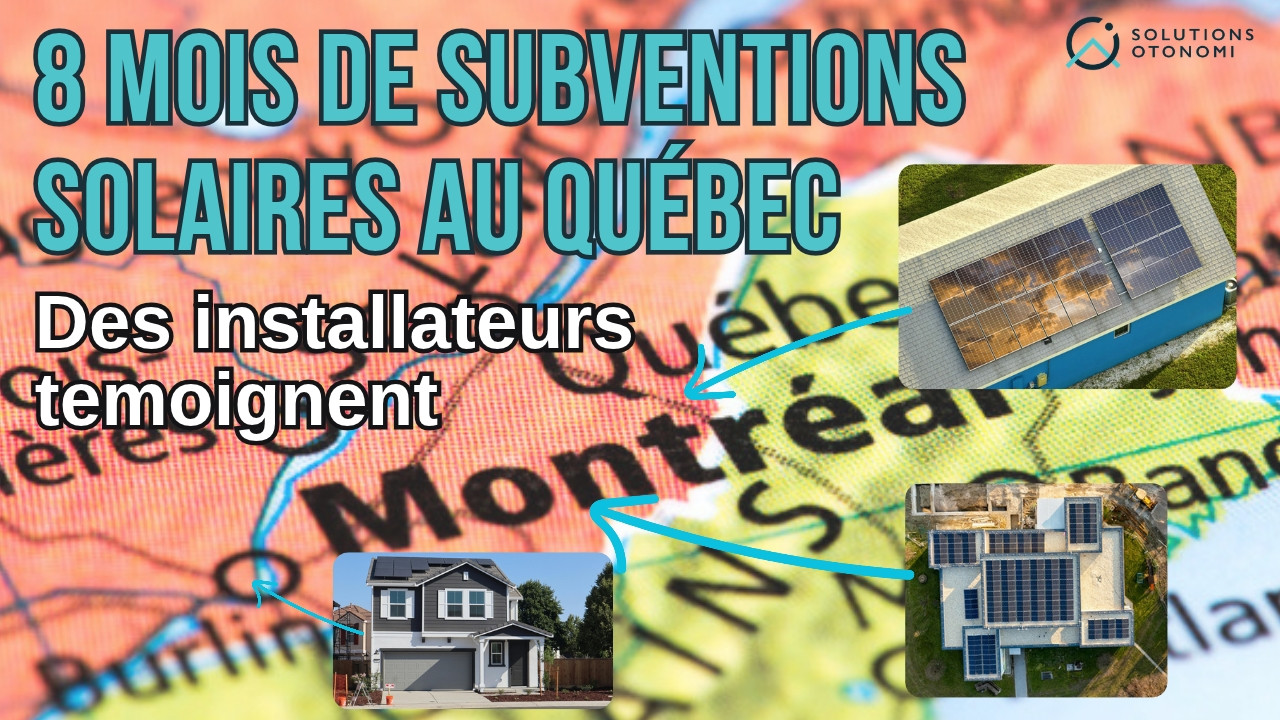
In the filing it submitted to the Régie de l'énergie, Hydro-Québec presented financial help for installing solar panels: $1,000 per installed kilowatt, up to 40% of the cost, with a residential and a commercial component.
Update (March 2026): the program has been in effect since March 31, 2026, through LogisVert for homes.
It is the body that regulates energy distributors in Quebec, somewhat like a tribunal, for both electricity and natural gas. Among other things, it rules on rates and on some Hydro-Québec programs.
In the episode, Floréal uses the example of a 6 kW system at about $15,000: without help, payback is around 15 to 18 years; with a $6,000 subsidy, the net cost drops to $9,000 and payback falls to about 10 to 13 years depending on the calculation. These estimates assume electricity rate increases of about 3% per year. Each project still needs to be assessed based on its consumption and roof.
The electricity produced is first used by the building. Surplus energy sent to the grid is credited in kilowatt-hours, one for one, and reduces later bills. It is not a sale of electricity: it is an exchange of kilowatt-hours. In France, by comparison, surplus energy is sold for less than it is bought, which pushes owners to use as much of it as possible themselves.
A non-profit organization, founded in 1983 according to its president Patrick Goulet, and now focused on photovoltaics. It has worked with Hydro-Québec on how solar is regulated, submitted a brief to a parliamentary committee and published a free guide to solar in Quebec.